You need to cite your source every time you:
- Directly quote an author.
- Paraphrase another author's work.
- Use factual information that is not considered common knowledge.
- Refer to another author's opinion, especially if it is a controversial opinion.
- Use data, images, graphs or other content that is not your original work.
- Use any data, information or opinions that are contentious or changeable even if they are commonly known.
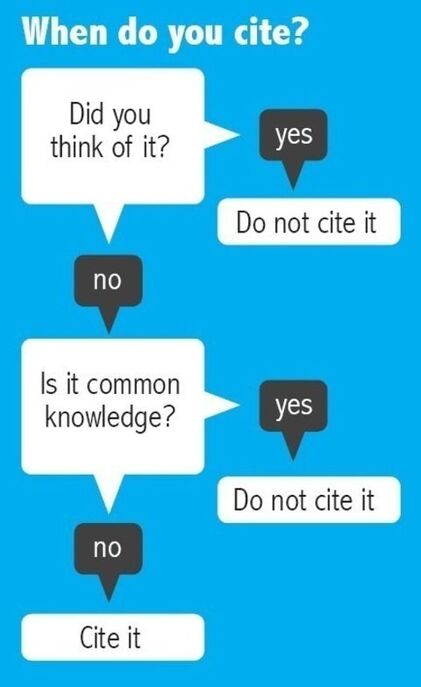
What is "common knowledge"?Common knowledge does not need to be cited in your essays and projects, but how do you know if something is common knowledge? Common knowledge is factual information that you can reasonably expect your audience to know. For example, an essay on a historical event written for Social Studies class may require fewer citations than a similar essay written for online publication. In the first instance, you can assume that your audience (your teacher and your classmates) will know many of the same basic facts that you know, so the general facts in your essay would be considered common knowledge for that audience. If you were to publish that same essay online for a wider audience, you would not be able to assume that they have the same knowledge as you, and you will need to cite more of your information.
For example, it is common knowledge, especially among Canadians, that Canada is a bilingual country whose official languages are English and French. This information is also a fact that could easily be looked-up and verified in many sources even if someone did not know this information already, so it would not require a citation. The specific percentage of Canadian citizens who speak both of our official languages would not be common knowledge, even among Canadians. If you were to use a graph comparing the number of Canadians who spoke only one of the official languages with those who spoke both, this information would require a citation. |
|
Things that are usually considered common knowledge:
If you are unsure about whether some of your research material requires a citation, it is always better to cite your source than to run the risk of being accused of plagiarism.
- Dates (e.g. Canada became an independent nation on July 1, 1867).
- Factual information that can be easily found in many sources and is not changeable (e.g. John A. Macdonald was Canada’s first prime minister).
- General statements that can be easily verified (e.g. Canada has a population of over 34 million people).
If you are unsure about whether some of your research material requires a citation, it is always better to cite your source than to run the risk of being accused of plagiarism.
Citing materials with page numbers:
When citing information a publication with page numbers, include the author's last name and the page number where you found the information in parentheses at the end of the borrowed information, but before any punctuation. This is the type of in-text citation you will use for most books, magazines, academic journals, novels, PDF files and newspapers.
DO NOT INCLUDE a comma between the name and page number.
Depending on how much information you include about the original author in your sentence, you have a few options for formatting your in-text citations.
DO NOT INCLUDE a comma between the name and page number.
Depending on how much information you include about the original author in your sentence, you have a few options for formatting your in-text citations.
If you are paraphrasing information and you mention the author's name in the sentence, just give the page number:
In her popular book, Quiet, Susan Cain argues that where we fall on the introvert-extrovert spectrum will shape our lives as much as our gender or race (2).
If you are paraphrasing information and you did not mention the author's name in the sentence, give the last name and page number:
Politics was in Winston Churchill’s blood. His grandfather also served as a Member of Parliament (Jenkins 4). He continued the family tradition by first serving as a Member of Parliament and later serving as the Prime Minister for a total of nine years.
If you are quoting an author whose name you mentioned in your sentence, just give the page number:
After studying the ruins of Great Zimbabwe, Gertrude Caton-Thompson concluded that they had been built by a "native civilization [of] . . . originality and amazing industry" (17).
If you are quoting an author, but you do not mention their name in your sentence, provide the author's last name and a page number:
The term Venus figurine is used to describe the more than 200 small statuettes of voluptuous female figures that have been found at Upper Paleolithic sites across Europe and some parts of Asia. "When paleoanthropologists refer to figurines as Venuses, [they] usually do so with air quote" (von Petzinger 95) because Venus figurines pre-date myths about the goddess Venus by thousands of years.
In her popular book, Quiet, Susan Cain argues that where we fall on the introvert-extrovert spectrum will shape our lives as much as our gender or race (2).
If you are paraphrasing information and you did not mention the author's name in the sentence, give the last name and page number:
Politics was in Winston Churchill’s blood. His grandfather also served as a Member of Parliament (Jenkins 4). He continued the family tradition by first serving as a Member of Parliament and later serving as the Prime Minister for a total of nine years.
If you are quoting an author whose name you mentioned in your sentence, just give the page number:
After studying the ruins of Great Zimbabwe, Gertrude Caton-Thompson concluded that they had been built by a "native civilization [of] . . . originality and amazing industry" (17).
If you are quoting an author, but you do not mention their name in your sentence, provide the author's last name and a page number:
The term Venus figurine is used to describe the more than 200 small statuettes of voluptuous female figures that have been found at Upper Paleolithic sites across Europe and some parts of Asia. "When paleoanthropologists refer to figurines as Venuses, [they] usually do so with air quote" (von Petzinger 95) because Venus figurines pre-date myths about the goddess Venus by thousands of years.
Citing materials without page numbers:
Many reliable sources of information will not have page numbers. These include websites, films and electronic publications. For these types of sources, it is not necessary to include page numbers or URLs in your in-text citations. Instead, you have a few options for citing your source depending on how you refer to it in your writing.
If you clearly refer to the source in a way that would make it easy to find in your Works Cited list, you don't need a parenthetical citation at all:
Saving Private Ryan's director, Steven Spielberg, has been applauded for accurately capturing the horror and chaos of the D-Day landings in World War II.
If you paraphrase information from a source, simply use the author's name in the in-text citation:
Thanks to popular Hollywood films, like Gladiator, many people today believe that gladiatorial combat was the most popular form of entertainment in the Roman Empire. Those people would be mistaken. The Romans' most beloved sport was actually chariot racing, which was equally dangerous and deadly (Trueman).
If you are citing a time-based media source, like YouTube or a film, include the range of hours, minutes and seconds you are referring to. If you don't refer to the source in your sentence, you should also include the title of the source:
In the Crash Course Study Skills episode on Procrastination, Thomas Frank advises students to break large assignments down into smaller tasks to help improve focus and become clearer about the actions they must take to be successful (00:03:28-00:04:09).
For prehistoric hunter-gatherers, the most successful hunting method was fishing, which explains why most early human settlements are found near rivers and coastal areas ("Agricultural Revolution" 00:02:20-00:02:44).
If you clearly refer to the source in a way that would make it easy to find in your Works Cited list, you don't need a parenthetical citation at all:
Saving Private Ryan's director, Steven Spielberg, has been applauded for accurately capturing the horror and chaos of the D-Day landings in World War II.
If you paraphrase information from a source, simply use the author's name in the in-text citation:
Thanks to popular Hollywood films, like Gladiator, many people today believe that gladiatorial combat was the most popular form of entertainment in the Roman Empire. Those people would be mistaken. The Romans' most beloved sport was actually chariot racing, which was equally dangerous and deadly (Trueman).
If you are citing a time-based media source, like YouTube or a film, include the range of hours, minutes and seconds you are referring to. If you don't refer to the source in your sentence, you should also include the title of the source:
In the Crash Course Study Skills episode on Procrastination, Thomas Frank advises students to break large assignments down into smaller tasks to help improve focus and become clearer about the actions they must take to be successful (00:03:28-00:04:09).
For prehistoric hunter-gatherers, the most successful hunting method was fishing, which explains why most early human settlements are found near rivers and coastal areas ("Agricultural Revolution" 00:02:20-00:02:44).
All materials cited within your paper should be included in your list of Works Cited.
Still not sure how to write in-text citations? Check out this instructional video:
Handling Tricky In-text Citations
Following the instructions given above, will help you write correctly formatted citations for most sources, but there are many cases where you will have to tweak the formatting (just like different types of sources require slightly different entry formats in a list of works cited). Here are the answers to the most frequently asked questions about how to cite a source.
How do I write an in-text citation for a source . . .
. . . with two authors?
Use both authors' last names.
(Wentz and Schellenberg 121)
(Lee and Hillenbrandt)
. . . with three or more authors?
Use the first author's last name followed by the abbreviation et. al. (it is an abbreviation for a Latin phrase that means "and others").
(Sekibo et. al. 431)
(Tran et. al.)
. . . with no author or an anonymous author?
When no author is listed, use a shortened title of the work instead.
(Beowulf 12)
("Veterans Remember")
. . . with a corporate author?
It is acceptable to use the name of a corporation if no author's name is given. Use abbreviations were appropriate to avoid overly long in-text citations.
(Nat'l Geographic 77)
(UNESCO)
How do I write an in-text citation if I am using . . .
. . . multiple works by the same author?
To distinguish between the different sources, include a shortened form of the title after the author's last name. Separate the author's name from the title with a comma. If you refer to the author by name in your sentence, you don't need to include their name in the parenthetical citation.
(Trueman, "D-Day")
(Trueman, "Churchill")
(Trueman, Great Battles 47)
(Great Battles 82)
. . . multiple sources by authors with the same last name?
Add their first initials to differentiate them. If they have the same first initial, include their first name along with their last name.
(Arthur Lee 389)
(Amy Lee par. 21)
(W. Lee 42)
. . . multiple volumes from a multi-volume work?
Include the volume number after the author's name followed by a colon. Then list the page number.
(Gupta 3: 227)
. . . lecture notes or an interview?
While the entry in the list of works cited is different for each of these sources, your in-text citation has the same format. Use the lecturer's or interviewee's last name and the date of the lecture or interview.
(Liew 14 Mar. 2016)
. . . a quote taken from a secondary source?
Ideally, you would find the original source and cite that, but if you are pressed for time or the original is unavailable, use the abbreviation "qtd. in" to indicate you are using a quotation referenced within a secondary source. The rest of the citation should follow the format that is appropriate for the type of source you are using. REMEMBER: This should only be used for direct quotes.
Churchill urged Londoners to remain brave so that future generations would say that "this was their finest hour" (qtd. in Miller 37).
. . . multiple sources to support the same point?
To cite multiple sources in the same in-text citation, separate them with a semi-colon. Format the reference to each source as you would if you were citing the sources individually.
Many historians have argued the importance of teaching historical thinking skills to high school students (Seixas and Morton 41; Case 12; "History Skills").
Matching Up Your In-Text Citations with Your List of Works Cited
No matter what format your in-text citations take, the information you include must match the first part of the entry for that source in your Works Cited. The short bit of information you include in your in-text citation, like the author's last name or a shortened title, must be what appears on the left-hand margin in the Works Cited.
If this sentence appeared in your essay:
We must remember that human beings are "symbol-using animals" (Burke 3).
Then you should make sure that there is a corresponding entry in your Works Cited that starts with that same last name:
Burke, Kenneth. Language as Symbolic Action: Essays on Life, Literature, and Method. University of California Press, 1966.
If this sentence appeared in your essay:
We must remember that human beings are "symbol-using animals" (Burke 3).
Then you should make sure that there is a corresponding entry in your Works Cited that starts with that same last name:
Burke, Kenneth. Language as Symbolic Action: Essays on Life, Literature, and Method. University of California Press, 1966.
Didn't find what you were looking for? Check out these helpful online resources:
